Child, teen & family therapy · Marin County, CA
Breathe. Play. Grow.
Connection at home. Confidence in the world.
Individual, group, and family therapy for toddlers through young adults and the parents and primary caregivers raising them, in Marin County and by telehealth across California.
What I want you to know
All behavior is meaningful.
Nobody who walks in here is a problem to be fixed. We work as a team: you, your child, and me, understanding together what's being asked for, and to build the kind of connection a child can go out into the world from.
Children do not act out. They ask, in the only language they have.
The meltdown, the shutdown, the refusal. None of it is random, and none of it means your child is broken or that you've failed them. Something is being communicated that hasn't found words yet.
Our job is to understand it before we try to change it, because behavior that gets managed without being understood tends to come back wearing a different outfit.
You bring what you see at home: the patterns, the triggers, the mornings that go sideways. Your child brings what they know about themselves. I bring the training and the questions. Between the three of us we work out what your family needs, and where you want to go with it. You set the goals; I help you get there.
What I'm working toward with every family is the same underlying thing: a household connected enough and steady enough that a child can venture out from it with confidence and trust.
You are the expert on you.
I don't know what it's like inside your head, and I'm not going to pretend I do. You're the only person who does.
My job is to help you show me. With words if you want, or with sand, or a drawing, or a game, or however it comes out. However you show me counts.
If you want your grownup in the room while we get to know each other, that is completely fine. Some people like that at first.
You're not in trouble here, and you're not broken. We're figuring this out together, and you get a say in all of it.
About
Meet your provider.

Symbria Coultas, MA, APCC, PhD student
My goal is to help families move beyond simply managing behaviors and build a more connected, resilient family system.
Most families reach out because of a behavior: the outbursts, the refusal to go to school, the argument that starts at 7:15 every single morning. Behavior is where we start, but it isn't where we stay. Underneath almost every stuck pattern is a need that hasn't found words yet. When the need gets met, the behavior tends to lose its job.
Underneath the technique, my thinking is attachment based, psychodynamic, and grounded in developmental psychology: what a child has learned to expect from the people closest to them, what is fair to expect of them at the age they are now, and what a pattern is still working to protect. With the youngest children that means treating the relationship between a child and their primary caregiver as the thing being worked on. I coach you in the moment, with your child right there, rather than taking a child away to be fixed and handed back. With older kids it means expressive work, sand and art and story, where a sturdier sense of self gets built rather than described. And mindfulness plain enough to be used before a test, in the back of the car, or as a child settles into bed, because anything fussier won't get used at all.
I have worked in this field for more than fourteen years: in dual diagnosis treatment with families, equine and outdoor programs, community mental health, county jails, child psychology clinics, and private practice. In that time I have learned there is very little a family can tell me that I have not sat with before. Whatever you have been most worried to say out loud is safe to say here.
My training began in addiction counseling and moved through a degree in Buddhist psychology and contemplative neuroscience, then master's degrees in transpersonal wilderness therapy and in clinical psychology. I'm currently working toward the completion of my PhD in clinical psychology.
I am a mother as well as a therapist. Outside of work I love spending time with my family, and enjoying the beautiful nature that surrounds us.
Our values
Five commitments every family gets.
Respect
A four year old and a fifteen year old both know when they're being talked about instead of talked to. Everyone in the room is a person with reasons, and your child is treated as the expert on their own experience, because they are.
Trust
Earned in the first few sessions, and the foundation for everything after. That means saying up front what I'll share with parents and caregivers and what I won't, keeping to it, and telling you the truth even when a softer version would go down easier.
Communication
All behavior is meaningful. A child who refuses school or falls apart at bedtime is saying something they don't have words for yet, and translation comes before correction. It runs the other direction too: you get my honest read in plain language, including when that read is that we should try something else.
Compassion
Families arrive tired, and often blaming themselves. You won't be judged here. Not for the morning you lost it, not for waiting a year to call. Change comes faster when nobody has to defend themselves first.
Play
Play isn't the warmup before the real therapy. For children it is the therapy. It's how they rehearse, test out being brave, and say what they can't say directly. Expect games, art, movement, and a fair amount of laughing.
In the room
What a session looks like.
Parents and caregivers often picture a child on a couch being asked how they feel. That is not how this goes, especially not with the young ones.
Play
For younger children, play is the language. Puppets, games, art, and figures let a child show me what happened and rehearse a different ending, without needing the vocabulary to describe any of it.
Sand tray
A tray of sand and a shelf of miniatures. A child builds a world, and what they build often says in ten minutes what months of direct questions never reach. Teens use it more often than you would guess.
Mindfulness practices
Practical, unfussy skills for a nervous system running hot: breath, grounding, noticing what the body is doing. Not sitting still for twenty minutes. Short practices a kid will actually use before a test, in the back of the car, and as they settle into bed.
Learning how you work
Every course of therapy here includes teaching. Children, teens and their parents or primary caregivers all get age specific explanations of what a nervous system does under stress, why a body reacts before a thought has arrived, and what that means for which strategies are helpful to them. Understanding why we do what we do makes change easier.
Skill building
We practice skills in session, so there is something to take home and try that same day. The following week we look at what worked, what fell apart, and why, then adjust. Over time each person builds their own toolbox, tuned to what helps them specifically, because what settles one child will not settle the next.
Talking
Talking happens at every age, at whatever pace the person sets. Some children are ready in the first session, others need weeks of play before words feel possible, and both are entirely fine. Talk therapy gives us a way to understand their experience fully, in their own words.
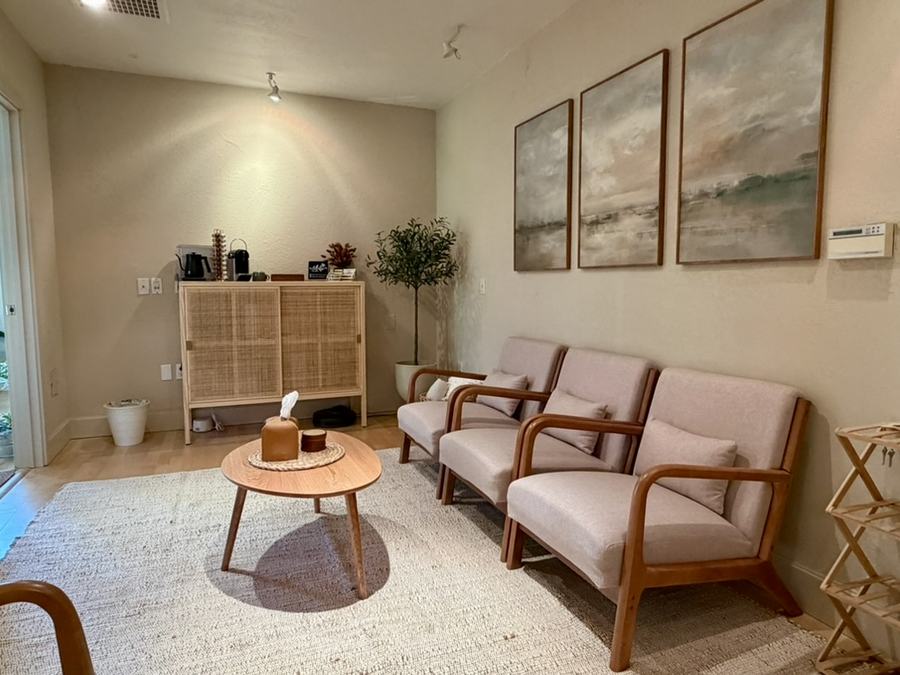


The office at 81 Throckmorton Ave, Mill Valley.
Services
Four ways to work together.
Many families use more than one. A child in individual therapy while their parents or caregivers meet with me separately for coaching, or a teen in individual therapy alongside a group.
Individual therapy
One to one work with a child, teen, or adult. Weekly fifty minute sessions, with regular parent and caregiver meetings built in for younger clients.
- Anxiety and emotional outbursts
- ADHD and autism
- School challenges and refusal
- Trauma, PTSD, and painful life events
- Depression and life transitions
An individualized plan will be created based on your unique needs
Group therapy
Small, closed groups running in six to eight week cycles. Part of what heals here comes from the other people in the room, because hearing a peer say the thing out loud does what no clinician can.
- Big Feelings, ages 4 to 5. Naming a feeling, finding where it sits in the body, and learning what to do with it.
- Teen group, ages 12 to 17, divided by age. A small circle working on pressure, friendship, and the question of who they are becoming.
- Parent and caregiver support and skill building. For parents and caregivers who want support and practical tools, alongside others who understand.
Following a short screening call, clients will be matched into a group based on age and needs
Family & couples therapy
The whole household, or the part of it that's stuck. We'll identify the pattern rather than assign the problem to one person in it. Together we work to understand how each person's reactions and emotions shape the whole family and how to meet everyone's needs for a more connected and resilient home.
- Family conflict that keeps repeating
- Parenting together across two households
- Couples work
- Routine check ins
Who comes to a session can change from week to week, depending on what your family needs
Parent and caregiver coaching
Work with the adults, with or without your child in the room. This often helps families progress faster, and I highly recommend it for young children. You leave with tools chosen specifically for your family, and together we create a plan for addressing what is happening at home.
- Strategies you can use the same evening
- Coaching in the moment, with your child present
- Support across one household or two
On its own, or alongside your child's therapy
Who I work with
From the first big feelings to their first apartment.
Toddlers & young children
Before they have the words
With the youngest children, most of the work happens with you. I coach you in the moment, with your child right there, so that what shifts between the two of you carries into the mornings and the bedtimes instead of staying in my office. Tantrums, defiance, separation and sleep all become easier to navigate once you can read what your child is actually asking for.
Children · roughly 7 to 12
Big feelings, small bodies
At this age worry often arrives as a stomachache, and a rough day at school comes out as tears or slammed doors at home. We work through those moments together, at a pace your child sets, so that they start to recognize what they are feeling and learn what they can do with it. A child who understands their own reactions has something of their own to draw on the next time the world asks a lot of them.
Teens & young adults
Pressure and identity
Teenagers and young adults come in carrying academic pressure, friendship ruptures, questions about who they are, and the particular loneliness of being technically an adult. Most of them arrive skeptical, which I think is fair enough. My job early on is to be someone worth talking to, and from there we work out together what they want their life to look like and how they might get there.
Parents, caregivers & families
The same argument, on repeat
Sometimes the pattern lives between the adults, and the child is the one carrying it. I meet with whole families, with couples, with parents raising children across two households, and with parents and caregivers on their own when you want support without putting your child in the room. The change that helps a child most often begins with the grownups.
Getting started
What the first month actually looks like.
Most parents and caregivers call without knowing what they're signing up for. Here's the sequence, so there are no surprises.
A free fifteen minute call
You describe what's happening; I tell you honestly whether I'm the right person for it, and who I'd suggest if I'm not. No charge, no pressure.
An intake session
When possible, it is best to have parents and/or primary caregivers present for the first session with children under 13 to discuss history, what has already been tried, what home looks like on a bad day, and what you are hoping changes. Teens and young adults start with their own first session instead, and we decide together from there how parents and caregivers are involved.
Getting to know your child and family
The first two or three sessions are about trust. We may play, draw, or talk while I assess the needs of the family or individual. That is the work at this stage. A young person who doesn't feel safe won't tell you anything true. If your child would rather have you in the room while we get to know each other, that is welcome. Plenty of children start that way and move to meeting on their own once they are ready.
A plan, and a rhythm
By around week four we settle into a regular time and a set of goals in plain language. That rhythm will most likely include routine check ins and family sessions, at a frequency we set together around what your family needs. A child's world is the household they live in, and shifting what happens there is most of the work. We revisit all of it as things change.
Fees & payment
Private pay, with a way in for families who need one.
I'm not in network with insurance plans. That keeps your child's care out of an insurer's hands. No required diagnosis on file, no session limits set by someone who has never met them. Here's what it costs, and how to get some of it back.
$285
Individual session
Child, teen, adult, or caregiver session. Payment is due at the time of service by card, Venmo, or HSA.
$325
Couples & family session
For work with more than one family member in the room, including couples sessions and work with caregivers in two households.
Sliding scale
By application
A limited number of reduced fee spots are held for families for whom the full fee would mean no therapy at all. Ask on the consult call. You don't need to justify it at length.
Superbills
Out of network
I'm not in network with insurance plans, but I provide a monthly superbill to submit to your insurer. Many PPO plans reimburse a meaningful share. Call the number on your card and ask about outpatient mental health, out of network.
Questions parents and caregivers ask
The ones that come up on nearly every call.
Will you tell me what my teenager says?
My kid says they don't want to come. Now what?
Do you prescribe medication?
How long does this usually take?
Can we mix individual, group, and family sessions?
What if we're already working with a school or another provider?
Get in touch
Start with a call. It costs nothing and takes fifteen minutes.
Tell me a little about your child and what's been happening. I reply within one to two business days. If I'm not the right fit, I'll point you toward someone who is.
The easiest way to start is a short email or text. Each button below opens a draft with a few simple questions already filled in, so you know exactly what to include.
Please keep your message general and save clinical detail for our call. Sending it does not begin a therapeutic relationship.
Mill Valley, CA 94941
If this is an emergency
This website and my voicemail are not monitored around the clock, and email is not the place for an emergency.
If your child is in immediate danger, call 911. For a mental health crisis, call or text 988, the Suicide & Crisis Lifeline, staffed 24 hours a day, including for parents and caregivers who need guidance about their child.
Credentials
MA, Clinical Psychology, Pacifica Graduate Institute
BA, Buddhist Psychology, Naropa University, with concentrations in Health and Healing and in Contemplative Neuroscience